
Bimetallic Injection Molding Screws: Extending Service Life Under Harsh Conditions
2025.12.10
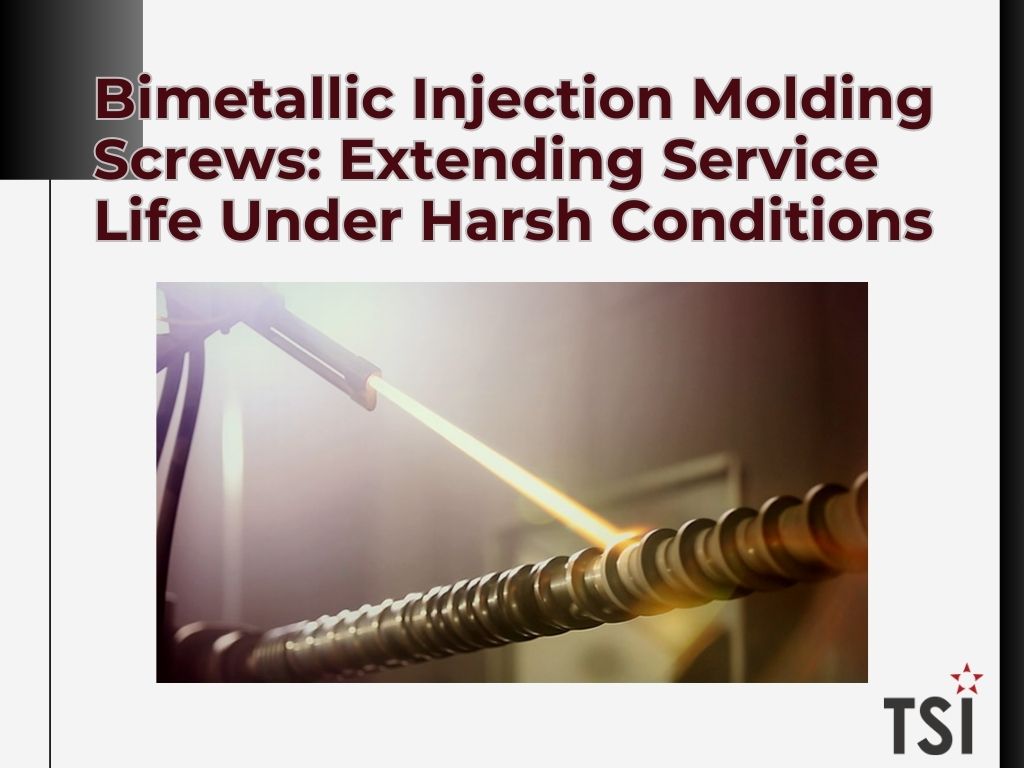
In modern injection molding, production demands continue to rise as manufacturers process more abrasive, corrosive, and high-temperature engineering plastics. Traditional nitrided or tool-steel screws often fail to withstand these challenging environments, leading to premature wear, inconsistent plasticizing, and costly machine downtime.
To address these challenges, bimetallic injection molding screws have become the industry’s preferred solution — offering significantly enhanced durability, stability, and long-term performance even in the harshest processing conditions.
What Makes a Screw “Bimetallic”?
A bimetallic screw consists of two key layers:
- Base Material (Substrate): High-strength alloy steel providing mechanical stability.
- Alloy Layer (Working Surface): A bonded layer of wear-resistant and corrosion-resistant material, often nickel-based or tungsten-based alloys.
This dual-layer construction provides a combination of hardness, toughness, and chemical resistance that single-material screws cannot match.
The alloy layer is typically applied through techniques such as spray welding or PTA coating, creating a dense metallurgical bond capable of withstanding extreme processing environments.
Why Bimetallic Screws Outperform Standard Screws
1. Superior Wear Resistance for Glass-Filled and Mineral-Filled Resins
Engineering plastics such as PA-GF, PC-GF, PPS, and PBT-GF contain glass fibers or mineral fillers that rapidly abrade traditional screws. Bimetallic screws maintain their geometry far longer thanks to the hard alloy layer, reducing screw wear, stabilizing melt quality, and prolonging both screw and barrel life.
2. Exceptional Corrosion Resistance
Materials like PVC, halogenated flame-retardant grades, and chemically reactive resins produce corrosive byproducts during processing. The nickel-based alloy layer in bimetallic screws resists pitting, chemical attack, and oxidation, preventing the surface degradation that commonly occurs with standard steels.
3. Improved Plasticizing Stability
Because the screw’s geometry remains stable longer, the plasticizing process stays consistent even after extended operation. This leads to:
- Consistent melt temperature and viscosity
- Improved shot repeatability
- Reduced material degradation
- Higher overall product quality
4. Reduced Maintenance and Lower Overall Cost of Ownership
Although bimetallic screws cost more initially, they dramatically reduce long-term maintenance costs by:
- Extending replacement intervals
- Minimizing downtime
- Protecting barrels from premature wear
- Reducing resin waste caused by inconsistent melt quality
When Should You Choose a Bimetallic Injection Molding Screw?
Bimetallic screws are strongly recommended when processing:
- Glass-fiber-filled engineering plastics
- Flame-retardant materials
- High-temperature resins
- Abrasive or recycled materials
- Corrosive additive-filled compounds
Any molding environment with high shear, high pressure, or frequent material changeovers benefits significantly from bimetallic durability.
How Screw Design Enhances the Benefits of Bimetallic Layers
While the alloy layer improves durability, the screw’s geometry plays an equally critical role in melt performance:
- Feed zone depth influences conveying efficiency
- Compression ratio affects melting and homogenization
- Metering zone design impacts output consistency
- Mixing elements enhance color dispersion and melt uniformity
Why TSI’s Bimetallic Screws Deliver Long-Lasting Performance
With over 50 years of industry experience, Tan Star Industries (TSI) brings deep technical expertise and continuous innovation to the development of bimetallic screws. Our end-to-end service capabilities — from design and manufacturing to technical support and after-sales service — ensure that every screw is engineered to meet the specific processing requirements of each customer.
Each bimetallic screw is produced through strict manufacturing control and rigorous quality assurance, providing strong wear and corrosion resistance, stable melt performance, and extended service life. TSI’s focus on customized engineering means every screw is matched to the resin type, process conditions, and performance goals of the molding application.
TSI is trusted by global manufacturers for dependable products, consistent quality, and reliable long-term support. Our bimetetallic screws are not only durable components — they are essential partners in achieving stable, efficient, and high-quality injection molding.
FAQ: Common Questions About Bimetallic Injection Molding Screws
1. What is the main advantage of a bimetallic screw over a standard nitrided screw?
Bimetallic screws offer significantly higher wear and corrosion resistance, making them ideal for glass-fiber-filled, abrasive, or corrosive materials.
2. How long does a bimetallic injection molding screw last?
Many users achieve 2–5 times longer lifespan compared to standard screws, especially in abrasive processing applications.
3. Are bimetallic screws compatible with all types of barrels?
Yes — they can be used with nitrided, bimetallic, or tri-metallic barrels. For maximum durability, pairing with a bimetallic or tri-metallic barrel is recommended.
4. Do bimetallic screws improve product quality?
Absolutely. They maintain geometric accuracy longer, which leads to improved melt stability, color dispersion, and overall product consistency.
5. Can TSI customize a bimetallic screw?
Yes. TSI provides fully customized screw designs tailored to resin type, shear sensitivity, mixing requirements, and production goals.
Conclusion — A Smarter Investment for Modern Injection Molding
As material requirements become more demanding, traditional screws simply cannot keep up. Bimetallic injection molding screws provide a long-lasting, reliable solution for manufacturers seeking stable melt quality, reduced downtime, and higher productivity.
Looking to improve your production performance?
Contact Tan Star Industries (TSI) to explore custom-engineered bimetallic screw solutions that enhance reliability and extend equipment lifespan.