
PTA Welding vs. HVOF Spray Coating: Which Surface Treatment Is Better for Plastic Processing Screws?
2026.07.14
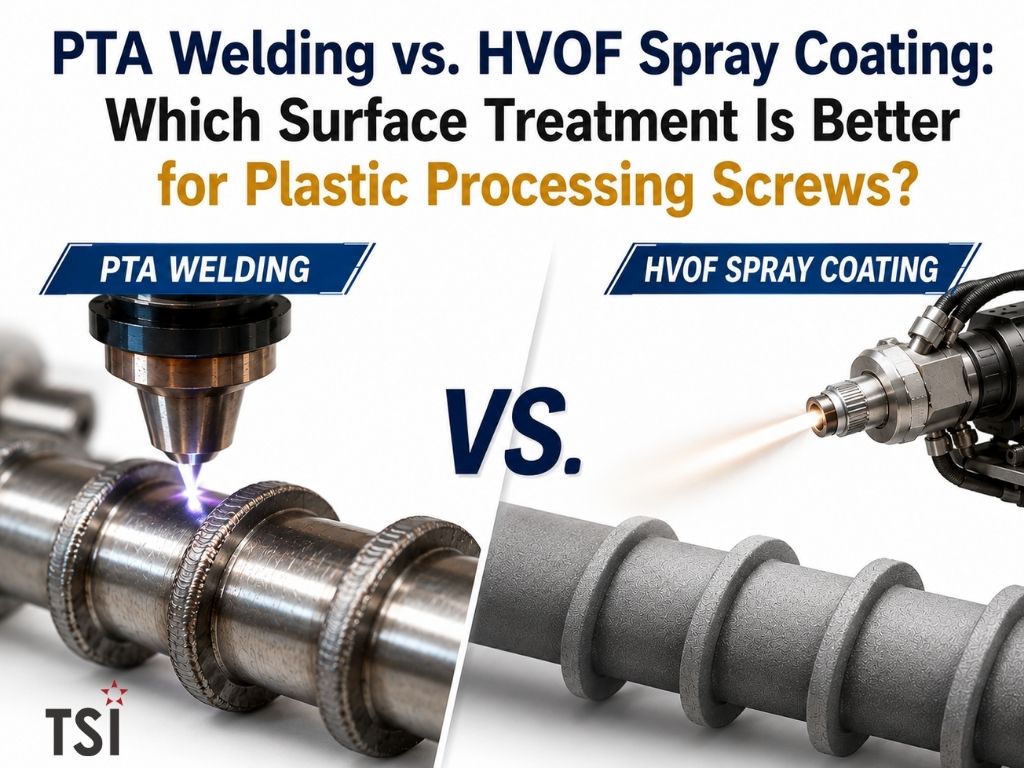
As engineering plastics continue to evolve, plastic processing screws are exposed to increasingly demanding operating conditions. Glass fiber reinforcement, mineral fillers, flame-retardant additives, and corrosive materials can all accelerate screw wear, shorten component lifespan, and increase maintenance costs.
To improve durability and processing stability, many manufacturers turn to advanced surface engineering technologies. Among the most common solutions are PTA Welding (Plasma Transferred Arc Welding) and HVOF Spray Coating (High Velocity Oxygen Fuel Spray Coating).
Although both technologies are designed to improve screw performance, they serve different purposes and are suited to different processing environments. Understanding their differences can help manufacturers select the most appropriate solution for their production requirements.
Why Surface Protection Is Important for Plastic Processing Screws
Plastic processing screws continuously convey, compress, and melt polymer materials during extrusion and injection molding. Over time, repeated contact with abrasive and chemically aggressive materials gradually wears away the screw flight surface.
Common causes of screw deterioration include:
-
Glass fiber reinforced plastics
-
Mineral-filled compounds
-
Flame-retardant materials
-
Recycled plastics containing contaminants
-
High-temperature processing environments
As wear progresses, manufacturers may notice:
-
Lower material throughput
-
Inconsistent melt quality
-
Increased maintenance frequency
-
Shorter screw service life
-
Higher production costs
Selecting the right surface treatment can significantly improve screw durability and help maintain stable production over extended operating periods.
What Is PTA Welding?
PTA Welding (Plasma Transferred Arc Welding) is a surface enhancement technology that deposits alloy materials onto the screw using a high-energy plasma arc.
During the process, both the alloy material and a thin layer of the screw surface are melted simultaneously. Once solidified, the deposited alloy becomes metallurgically bonded to the base material, forming a durable protective layer on the screw flight.
Because the alloy is fused directly to the screw, PTA Welding provides excellent durability under continuous mechanical loading. Different alloy systems can also be selected according to the processing environment, allowing manufacturers to balance wear resistance and corrosion protection for different applications.
At TAN STAR, PTA Welding solutions include:
-
S-59 #12 – Cobalt-based alloy designed for enhanced corrosion resistance
-
S-59 #56 – Nickel-chromium alloy providing balanced wear and corrosion protection
-
S-59 #88 – Nickel-chromium-tungsten alloy developed for higher wear resistance in reinforced plastic applications
What Is HVOF Spray Coating?
HVOF (High Velocity Oxygen Fuel) Spray Coating is an advanced thermal spray process that applies alloy particles to the screw surface at extremely high velocity.
Unlike PTA Welding, HVOF does not melt the base material. Instead, coating particles are accelerated toward the prepared surface to create a dense and highly durable protective coating.
The resulting coating offers excellent wear resistance, corrosion resistance, and surface integrity while maintaining stable processing performance under demanding operating conditions.
TAN STAR offers HVOF coating solutions including:
-
S-42 – Tungsten carbide (WC-Co) coating designed for outstanding wear resistance, suitable for processing materials containing glass fiber up to 60%.
-
S-75 – Nickel-chromium coating developed for excellent corrosion resistance in chemically aggressive processing environments.
PTA Welding vs. HVOF Spray Coating
Although both technologies improve screw durability, they utilize different engineering approaches.
| Comparison | PTA Welding | HVOF Spray Coating |
|---|---|---|
| Process Type | Plasma Transferred Arc Welding | Thermal Spray Coating |
| Surface Formation | Alloy is welded onto the screw flight | Protective coating is sprayed onto the surface |
| Bonding Method | Metallurgical bond | Dense bonded coating |
| Main Purpose | Reinforce critical screw-flight wear areas | Provide advanced surface protection |
| Wear Resistance | Depends on alloy selection | Depends on coating selection |
| Corrosion Resistance | Depends on alloy selection | Depends on coating selection |
| TAN STAR Products | S-59 #12 / #56 / #88 | S-42 / S-75 |
Rather than asking which technology is universally better, manufacturers should consider which solution best matches their processing materials and operating conditions.
When Should You Choose PTA Welding?
PTA Welding is often selected when manufacturers require reinforcement of the screw flights, where wear occurs most frequently.
Typical applications include:
-
Engineering plastics
-
Glass fiber reinforced materials
-
Flame-retardant compounds
-
Recycled plastics
-
Continuous production requiring long screw life
Because multiple alloy systems are available, PTA Welding allows processors to select a solution based on the balance of wear resistance and corrosion protection required for their application.
When Is HVOF Spray Coating the Better Choice?
HVOF Spray Coating is well suited for applications requiring high-performance surface protection against severe wear or corrosive processing environments.
For example:
-
S-42 is designed to provide outstanding wear resistance for highly abrasive materials.
-
S-75 focuses on corrosion resistance where chemically aggressive materials may accelerate component deterioration.
The dense coating produced by HVOF technology helps maintain screw surface integrity while supporting stable long-term processing performance.
How TAN STAR Helps Customers Select the Right Solution
Every plastic processing application presents different challenges. Material composition, glass fiber content, processing temperature, and production volume all influence screw performance and service life.
Rather than recommending a single solution for every application, TAN STAR provides multiple surface engineering technologies that can be selected according to specific processing requirements.
Whether the priority is improved wear resistance, enhanced corrosion protection, or a balanced combination of both, TAN STAR's PTA Welding and HVOF Spray Coating solutions are designed to support longer component life, reduced maintenance requirements, and more stable production performance.
FAQ
Is PTA Welding better than HVOF Spray Coating?
Neither technology is universally better. The appropriate choice depends on the processing material, operating conditions, and performance requirements.
Which surface treatment is better for glass fiber reinforced plastics?
Both technologies can improve screw durability. The optimal solution depends on the glass fiber content and the required balance between wear resistance and corrosion protection.
Can both technologies extend screw service life?
Yes. PTA Welding and HVOF Spray Coating are both designed to reduce wear and corrosion, helping improve screw longevity and production reliability.
Does TAN STAR offer multiple alloy options?
Yes. TAN STAR provides several PTA Welding alloy systems and HVOF Spray Coating solutions to accommodate different plastic processing environments.
How do I choose the right surface treatment?
Factors such as resin type, filler content, processing conditions, and production requirements should all be considered. Consulting with an experienced manufacturer can help determine the most suitable solution.
Conclusion
PTA Welding and HVOF Spray Coating are both effective technologies for improving the performance of plastic processing screws, but they are designed for different processing challenges. PTA Welding creates a durable metallurgically bonded alloy layer on critical wear areas, while HVOF Spray Coating provides dense surface protection against severe wear and corrosion.
Instead of focusing on which technology is "better," manufacturers should evaluate their processing materials, operating conditions, and maintenance objectives to determine the most appropriate solution.
With decades of experience in screw manufacturing and advanced surface engineering technologies, TAN STAR INDUSTRIES INC. offers both PTA Welding and HVOF Spray Coating solutions to help processors extend component life, improve production stability, and achieve reliable long-term performance.
Ready to Improve the Performance of Your Plastic Processing Screws?
Whether you're processing engineering plastics, glass fiber reinforced compounds, or corrosive materials, TAN STAR INDUSTRIES INC. can help you select the most suitable surface engineering solution. Contact our technical team to discuss your application and discover how our PTA Welding and HVOF Spray Coating technologies can support longer service life and more stable production performance.