
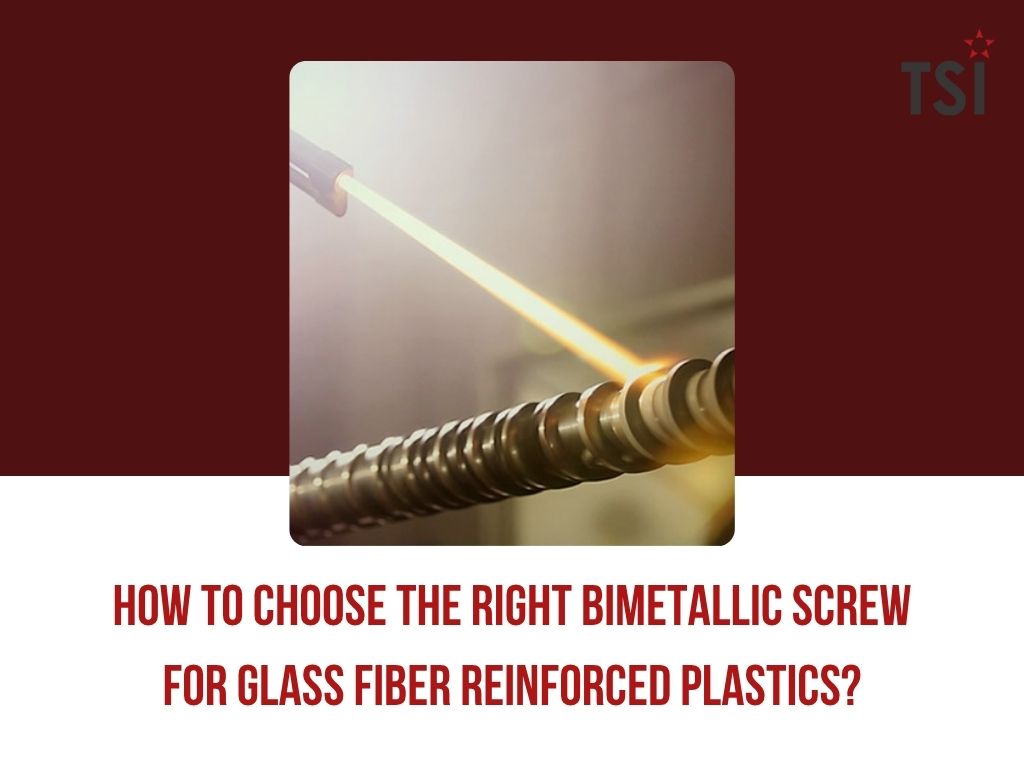
Glass fiber reinforced plastics offer higher strength, stiffness, and dimensional stability, making them widely used in demanding applications. However, the same glass fibers that improve the performance of finished products can create severe abrasive wear on plastic processing screws.
For processors working with glass fiber reinforced plastics, choosing the right bimetallic screw is therefore an important part of maintaining screw life, processing stability, and production efficiency. The appropriate solution depends not only on glass fiber content, but also on the required balance between wear resistance, corrosion resistance, screw hardness, and processing conditions.
TAN STAR INDUSTRIES INC. provides bimetallic screw solutions using technologies including PTA Welding, HVOF Spray Coating, and Through Hardened treatments, allowing screw performance to be matched to different plastic processing requirements.
Table of Contents
- Quick Takeaway
- Why Glass Fiber Reinforced Plastics Cause Screw Wear
- What Makes a Bimetallic Screw Suitable for Glass Fiber?
- How Glass Fiber Content Affects Screw Selection
- Wear Resistance vs. Corrosion Resistance
- PTA Welding vs. HVOF vs. Through Hardened
- How to Select the Right Bimetallic Screw
- Why Screw Selection Should Be Application-Based
- FAQ
- Conclusion: Choosing the Right Bimetallic Screw for Glass Fiber
Quick Takeaway
- Glass fiber can significantly increase abrasive wear on plastic processing screws.
- Higher glass fiber content generally requires greater attention to screw surface protection.
- Wear resistance is important, but corrosion resistance may also matter depending on the resin and additives.
- Bimetallic screw solutions can combine a strong base material with a wear- or corrosion-resistant surface layer.
- PTA Welding, HVOF Spray Coating, and Through Hardened treatments offer different performance characteristics.
- The right screw should be selected according to the material, glass fiber content, processing conditions, and required service life rather than hardness alone.
Why Glass Fiber Reinforced Plastics Cause Screw Wear
Glass fiber reinforced plastics contain glass fibers that improve the mechanical properties of the final product. During plasticizing, however, these hard fibers continuously contact the screw surface.
This creates an abrasive environment, particularly around the screw flights and other areas where material movement and friction are concentrated.
Over time, excessive wear can change the original screw geometry. When the flight dimensions are gradually reduced, the screw may no longer convey, compress, and plasticize material as efficiently as it did when new.
TSI specifically notes that glass fiber, carbon fiber, mineral additives, and heat-resistant chemical additives can create serious abrasion and reduce the service life of conventional screws and barrels.
For this reason, selecting a screw based only on the base steel is often insufficient for highly abrasive compounds.
What Makes a Bimetallic Screw Suitable for Glass Fiber?
A bimetallic screw is designed to combine the structural properties of a base material with a more specialized alloy or hardened surface.
The objective is to protect critical screw surfaces from the demanding conditions created during plastic processing.
For glass fiber reinforced materials, the most important consideration is usually wear resistance. However, the best solution is not necessarily the screw with the highest hardness rating.
A suitable bimetallic screw should be evaluated according to:
- Glass fiber content
- Resin type
- Abrasive additives
- Corrosive additives
- Processing temperature
- Required production life
- Required balance between wear and corrosion resistance
This application-based approach is more reliable than choosing a screw simply because it has the highest advertised hardness.
How Glass Fiber Content Affects Screw Selection
The amount of glass fiber in a resin is one of the key factors to consider when selecting a screw.
As the proportion of glass fiber increases, the potential for abrasive contact also increases. This means processors using highly reinforced materials may need more advanced surface protection than applications using a small amount of glass fiber.
TSI's current product specifications demonstrate how different surface technologies can be matched with different glass fiber applications.
| Surface Treatment | Example | Main Base | Hardness | Glass Fiber Application |
|---|---|---|---|---|
| HVOF Spray Coating | S-42 | WC | HV 1100–1400 | ≤60% |
| HVOF Spray Coating | S-75 | Ni | HV 900–1100 | ≤40% |
| PTA Welding | S-59 #56 | Ni | HRC 52–55 | ≤10% |
| PTA Welding | S-59 #88 | Ni | HRC 58–60 | ≤25% |
| Through Hardened | S-08 | Cr | HRC 62–64 | ≤60% |
| Through Hardened | S-23 | Cr | HRC 60–62 | ≤40% |
These specifications illustrate an important point: there is no single bimetallic screw specification that is ideal for every glass fiber application. Different alloy systems and surface treatments provide different combinations of hardness, wear resistance, and corrosion resistance.
Wear Resistance vs. Corrosion Resistance
When processing glass fiber reinforced plastics, wear resistance is an obvious priority. However, it should not be the only consideration.
Some plastic compounds contain additives that can create corrosive processing environments. Flame retardants and certain engineering plastics, for example, may place additional chemical demands on the screw surface.
This creates two different types of surface damage:
Abrasive Wear
Hard particles such as glass fibers physically wear away the screw surface.
Corrosion
Chemically aggressive materials attack the screw surface and can cause degradation or pitting.
The right screw therefore needs to match the dominant failure mechanism.
For example, TSI's HVOF S-42 uses a tungsten carbide-based coating with a reported hardness of HV 1100–1400 and is specified for glass fiber applications up to 60%. Its listed wear resistance is five stars, while corrosion resistance is four and a half stars.
By contrast, the HVOF S-75 uses a nickel-based system with chromium and emphasizes corrosion resistance while supporting glass fiber applications up to 40%.
This demonstrates why application conditions should determine material selection.
PTA Welding vs. HVOF vs. Through Hardened
For glass fiber reinforced plastics, different surface technologies can provide different approaches to protecting the screw.
PTA Welding
PTA Welding, or Plasma Transferred Arc Welding, deposits an alloy layer onto the screw surface using a plasma arc. The process creates a metallurgical bond between the deposited alloy and the base material.
TSI applies PTA treatment particularly to screw flights, which are exposed to significant wear during processing. The company offers different PTA alloy systems with different combinations of wear and corrosion resistance.
PTA Welding may be considered when specific screw areas require localized alloy protection.
HVOF Spray Coating
HVOF, or High Velocity Oxygen Fuel, uses high particle velocity to apply a protective coating onto the prepared screw surface.
TSI describes HVOF as a technology capable of producing dense, strongly bonded coatings with high wear and corrosion resistance. Its S-42 solution, for example, is specified for glass fiber content up to 60%.
HVOF can therefore be particularly attractive for applications requiring strong surface wear protection.
Through Hardened
Through Hardened screws use a hardened material throughout the relevant screw structure rather than relying only on a localized deposited layer.
TSI's Through Hardened range includes several Cr-based options. For example, S-08 has an inlay hardness of HRC 62–64 and is specified for glass fiber content up to 60%, while S-23 has HRC 60–62 hardness and is specified for glass fiber content up to 40%.
The appropriate technology depends on the required performance balance and processing application.
How to Select the Right Bimetallic Screw
When evaluating a bimetallic screw for glass fiber reinforced plastics, consider the following factors.
1. Identify the Glass Fiber Content
Start with the percentage of glass fiber in the material.
A screw designed for low glass fiber content may not be the best choice for a compound containing significantly higher reinforcement.
2. Consider the Resin
Different resins create different processing conditions. Engineering plastics may involve higher temperatures or additional chemical additives compared with general-purpose plastics.
The resin should therefore be considered together with the reinforcement content.
3. Determine the Dominant Wear Mechanism
Ask whether the main concern is:
- Abrasive wear
- Corrosion
- A combination of both
This helps narrow down the appropriate alloy and surface treatment.
4. Compare Wear and Corrosion Resistance
A high hardness value does not automatically mean the screw is the best choice.
For example, TSI's product specifications show that different solutions achieve different balances between wear resistance and corrosion resistance.
5. Consider Production Requirements
For continuous production, frequent screw replacement can result in maintenance costs and downtime.
A higher-performance screw may therefore be justified when long production cycles and stable processing are priorities.
Why Screw Selection Should Be Application-Based
A common mistake is to select a screw based on one specification, such as hardness.
Hardness is useful, but it does not fully describe how a screw will perform in an actual plastic processing environment.
A more complete evaluation should consider:
Material → Glass Fiber Content → Abrasion → Corrosion → Surface Treatment → Required Service Life
This approach helps processors choose a screw based on actual operating conditions rather than simply comparing individual specifications.
TSI's bimetallic screw portfolio reflects this application-oriented approach, with different PTA Welding, HVOF Spray Coating, and Through Hardened solutions available for different processing requirements.
FAQ
Is a bimetallic screw suitable for glass fiber reinforced plastics?
Yes. Bimetallic screw solutions can provide enhanced wear and corrosion resistance for demanding plastic processing applications. The appropriate material and surface treatment should be selected according to the glass fiber content and processing conditions.
Why does glass fiber cause screw wear?
Glass fibers are hard reinforcing materials that can create continuous abrasive contact with the screw surface during plastic processing. Higher glass fiber content can therefore increase the demand for wear-resistant screw materials and surface treatments.
Is higher hardness always better for glass fiber applications?
No. Hardness is only one factor in screw selection. Wear resistance, corrosion resistance, resin type, glass fiber content, processing conditions, and required service life should also be considered.
Which surface treatment is suitable for high glass fiber content?
The appropriate treatment depends on the complete processing environment. TSI offers solutions such as HVOF S-42 and Through Hardened S-08 for applications with glass fiber content up to 60%, while other solutions are designed for different levels of reinforcement and corrosion requirements.
How can I choose the right bimetallic screw?
Start by evaluating the resin, glass fiber percentage, additives, processing temperature, wear mechanism, and expected production life. These factors can then be matched with the appropriate alloy and surface treatment.
Conclusion: Choosing the Right Bimetallic Screw for Glass Fiber
Glass fiber reinforced plastics can significantly increase abrasive stress on plastic processing screws. As glass fiber content and processing demands increase, conventional screw surfaces may not provide sufficient long-term protection.
A properly selected bimetallic screw can provide enhanced protection against wear and, depending on the alloy system, corrosion as well.
The best choice should not be based on hardness alone. Processors should evaluate glass fiber content, resin type, abrasive and corrosive additives, required wear resistance, processing conditions, and expected service life.
For demanding applications, technologies such as PTA Welding, HVOF Spray Coating, and Through Hardened treatment provide different approaches to improving screw durability. TAN STAR's range of surface-engineered screw solutions allows the treatment and material system to be matched to specific plastic processing requirements.
If you are processing glass fiber reinforced plastics and need help selecting the appropriate screw solution, TAN STAR INDUSTRIES INC. can evaluate your material and processing requirements and recommend a suitable bimetallic screw configuration. Contact our team today to discuss your application and find the right solution for your plastic processing needs.