
TNP Shot Peening vs. Conventional Shot Peening: What’s the Difference?
2026.01.12
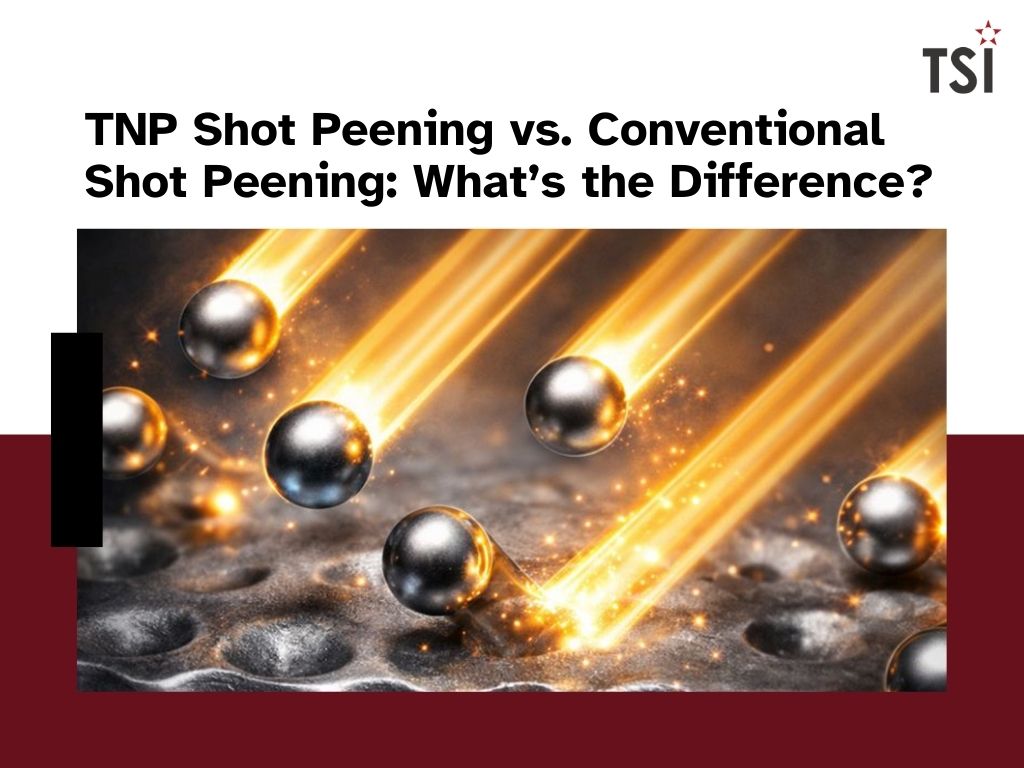
In modern manufacturing, improving surface durability and fatigue resistance has become essential for high-performance mechanical components. Shot peening is a widely adopted surface treatment process that enhances metal strength by introducing controlled compressive stress.
However, not all shot peening processes deliver the same results. As precision requirements increase, TNP Shot Peening has emerged as an advanced alternative to conventional shot peening — providing superior surface refinement, stability, and performance for high-demand applications.
This article explains how TNP Shot Peening differs from traditional methods, and why manufacturers are increasingly adopting this technology for critical components.
Understanding Conventional Shot Peening
Conventional shot peening propels steel or ceramic shots onto a metal surface at high velocity. Each impact plastically deforms the surface, creating compressive residual stress. This process:
- Improves fatigue strength
- Reduces crack propagation
- Enhances wear resistance
- Extends component service life
Traditional shot peening typically uses shot particles ranging from 0.3 mm to 1.0 mm in diameter. While effective for general mechanical parts, the process can leave relatively rough surface textures, limiting its suitability for high-precision or micro-tolerance components.
What Is TNP Shot Peening?
TNP (Tan Star Nano Peening) is an advanced shot peening technology developed to achieve ultra-fine surface treatment using micro-sized particles, significantly smaller than those used in conventional peening.
Instead of large shot media, TNP Shot Peening uses extremely fine particles accelerated at high speed to create:
- Uniform surface compression
- Minimal surface roughness
- Improved micro-hardness
- Superior dimensional stability
This makes TNP Shot Peening ideal for precision components where surface finish and accuracy are critical.
Key Differences Between TNP and Conventional Shot Peening
1. Shot Particle Size
- Conventional Shot Peening: 0.3 – 1.0 mm shot size
- TNP Shot Peening: Ultra-fine micro-particles
Smaller particles allow TNP to achieve high compressive stress without leaving deep surface indentations, resulting in a smoother and more controlled surface profile.
2. Surface Finish Quality
Traditional peening improves strength but often increases surface roughness. TNP Shot Peening, by contrast, produces:
- Finer surface texture
- Lower friction coefficient
- Reduced operational noise
- Better compatibility with sliding or rotating parts
3. Dimensional Accuracy
Large shot impacts in conventional peening can slightly deform thin or delicate parts. TNP’s micro-impact approach maintains:
- Tight dimensional tolerances
- Minimal part distortion
- Stable geometry after treatment
4. Fatigue and Wear Performance
Both methods introduce compressive residual stress. However, TNP Shot Peening creates a more uniform surface stress layer, improving:
- Fatigue life
- Crack resistance
- Long-term wear durability
5. Application Range
| Application Type | Conventional Shot Peening | TNP Shot Peening |
|---|---|---|
| Automotive gears & springs | ✓ | ✓ |
| General machinery parts | ✓ | ✓ |
| Precision mold components | △ | ✓✓ |
| Medical & surgical tools | △ | ✓✓ |
| Optical & lens parts | △ | ✓✓ |
| High-speed rotating parts | ✓ | ✓✓ |
(✓✓ = Highly Suitable)
Why Manufacturers Choose TNP Shot Peening
As product tolerances shrink and performance demands rise, manufacturers require surface treatment methods that strengthen parts without sacrificing precision.
TNP Shot Peening provides:
- Strong fatigue enhancement
- Superior surface smoothness
- Controlled residual stress
- Long-term stability
- Compatibility with micro-precision components
This makes it a preferred solution for industries such as:
- Precision machinery
- Household appliance components
- Medical equipment
- Optical and lens systems
- Industrial automation parts
TSI’s Expertise in TNP Shot Peening
With decades of experience in metal surface processing, Tan Star Industries (TSI) developed TNP Shot Peening to meet modern manufacturing demands for both durability and precision.
TSI’s TNP Shot Peening process utilizes ultra-fine particles and controlled processing conditions to deliver:
- Reduced surface friction
- Lower operational noise
- Enhanced wear resistance
- Improved product consistency
By integrating TNP Shot Peening into its manufacturing solutions, TSI helps customers extend component lifespan while maintaining tight dimensional accuracy and surface integrity.
FAQ: Common Questions About TNP Shot Peening
1. What is the main purpose of shot peening?
Shot peening is a surface treatment process designed to introduce compressive residual stress into metal surfaces. This improves fatigue strength, enhances wear resistance, and helps prevent crack initiation during long-term operation.
2. How is TNP Shot Peening different from conventional shot peening?
TNP Shot Peening uses ultra-fine particles instead of conventional large shots. This allows it to create compressive stress while maintaining a smoother surface finish and tighter dimensional control, making it suitable for high-precision components.
3. Does TNP Shot Peening increase surface hardness?
Yes. TNP Shot Peening refines the surface layer and improves micro-hardness, which helps reduce friction and slow down surface wear during continuous mechanical operation.
4. Can TNP Shot Peening be applied to small or thin parts?
Yes. Because TNP uses micro-sized particles, it can treat delicate or thin components without causing deformation or dimensional distortion, which may occur in conventional shot peening.
5. What industries commonly use TNP Shot Peening?
TNP Shot Peening is widely used in precision machinery, household appliance components, industrial equipment, medical devices, and optical parts where both durability and surface accuracy are required.
Conclusion — Choosing the Right Peening Technology Matters
While conventional shot peening remains effective for many industrial parts, it may not meet the requirements of today’s high-precision components.
TNP Shot Peening bridges the gap — offering the strength benefits of traditional peening combined with the surface refinement needed for advanced manufacturing.
Looking to enhance your component performance?
Contact Tan Star Industries (TSI) to learn how TNP Shot Peening can upgrade your surface treatment process.