
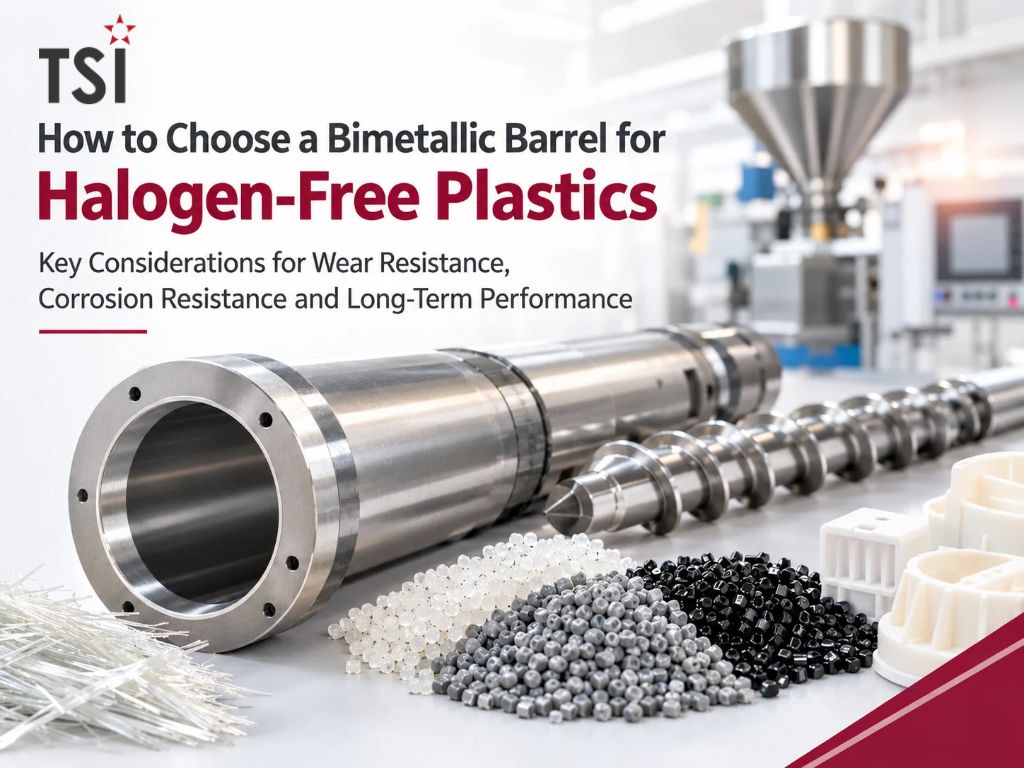
Halogen-free flame-retardant plastics are increasingly used in electrical components, electronic housings, automotive parts, and industrial applications where fire safety and material performance are important. However, these specialized compounds can create demanding processing conditions for injection molding and extrusion equipment.
Depending on their formulation, flame-retardant additives, reinforcing fibers, and mineral fillers may contribute to abrasive wear, while certain additives or degradation products may create chemical compatibility concerns.
For manufacturers processing these materials, selecting the right bimetallic barrel is essential to maintaining equipment durability, stable plasticizing performance, and long-term production efficiency.
TAN STAR INDUSTRIES INC. provides nickel-based bimetallic barrels designed for different processing requirements, including the T-60 series for demanding engineering plastic applications.
This article explains how halogen-free flame-retardant plastics affect barrel selection, which material properties matter most, and when a high-performance nickel-based barrel should be considered.
1. What Are Halogen-Free Flame-Retardant Plastics?
Halogen-free flame-retardant plastics are polymer compounds formulated to meet specified flame-resistance requirements without intentionally relying on halogen-containing flame-retardant systems.
They are commonly considered for applications involving electrical insulation, electronic equipment, automotive components, and other products subject to fire-safety requirements.
These compounds may contain different flame-retardant systems, including phosphorus-based additives, metal hydroxides, and other specialized formulations.
Their processing characteristics vary according to the base resin and additive package.
Why Does the Formulation Matter?
Two materials described as halogen-free flame-retardant plastics may behave very differently during processing.
For example, one formulation may contain substantial mineral filler content, while another may combine flame-retardant additives with glass fiber reinforcement.
These differences affect melt behavior, processing temperature, abrasive loading, and the demands placed on screw and barrel surfaces.
2. Why Can Halogen-Free Flame-Retardant Plastics Cause Barrel Wear?
Barrel wear in halogen-free flame-retardant processing is primarily influenced by the compound's fillers, reinforcement, operating conditions, and chemical behavior.
Halogen-free materials are not inherently more abrasive or corrosive than all conventional plastics. The risks depend on their ingredients.
Abrasive Wear from Fillers
Some flame-retardant formulations contain mineral additives or glass fibers that increase contact between hard particles and the barrel's internal surface.
During plasticizing, repeated contact can gradually remove material from the barrel lining.
Combined Reinforcement and Flame Retardancy
Engineering plastics may contain both glass fibers and flame-retardant additives to achieve mechanical strength and fire performance.
This combination can increase the importance of abrasion resistance, particularly during high-throughput production.
Chemical Compatibility and Degradation
Halogen-free does not automatically mean corrosion-free.
Certain formulations, contaminants, or degradation products may affect metal surfaces under specific processing conditions.
The risk depends on the resin chemistry, temperature, residence time, and additives involved.
Processing Temperature and Mechanical Loading
High temperatures, elevated pressures, and demanding operating cycles can place additional stress on plasticizing components.
Although these factors do not necessarily cause wear independently, they can influence how the barrel performs when processing abrasive compounds.
3. What Makes a Bimetallic Barrel Suitable for Flame-Retardant Plastics?
A bimetallic barrel combines a structural steel body with a protective alloy lining on the internal working surface.
The outer structure provides mechanical support, while the inner alloy is selected to resist the wear or corrosion conditions encountered during processing.
Why Is the Inner Alloy Important?
The barrel's internal surface is exposed to continuous contact with molten polymer, fillers, and the rotating screw.
A suitable alloy lining helps protect the bore against material loss and surface deterioration.
By slowing dimensional wear, it may help maintain the designed operating clearance between the screw and barrel.
Why Consider Nickel-Based Alloys?
Nickel-based bimetallic barrel linings can provide useful combinations of wear resistance and corrosion resistance.
TAN STAR's nickel-based barrel range incorporates alloying elements such as tungsten and chromium, with different hardness and performance ratings depending on the grade.
However, nickel content alone does not establish suitability. The complete alloy system and processing environment must be evaluated.
Explore TAN STAR's Nickel-Based Bimetallic Barrels to compare available product grades.
4. How to Evaluate Wear and Corrosion Resistance
When selecting a barrel for flame-retardant engineering plastics, manufacturers should evaluate two different types of protection.
Wear Resistance
Wear resistance refers to the barrel lining's ability to withstand abrasive contact and mechanical material loss.
This becomes especially important when compounds contain glass fibers, mineral fillers, or other abrasive ingredients.
A suitable wear-resistant lining can help preserve the barrel's internal dimensions during extended production.
Corrosion Resistance
Corrosion resistance concerns the lining's compatibility with chemically aggressive processing conditions.
Potential concerns include certain additives, degradation products, and contaminants.
The exact risk must be determined from the material formulation and processing conditions.
Why Hardness Alone Is Not Enough
Hardness is a useful specification, but it does not fully describe performance.
Two alloys with similar hardness values may differ in microstructure, toughness, corrosion resistance, and response to specific abrasive materials.
Therefore, selecting the highest-hardness barrel is not automatically the most appropriate decision.
| Selection Factor | Why It Matters |
|---|---|
| Alloy Hardness | Helps indicate resistance to certain wear mechanisms |
| Abrasion Resistance | Important for glass fiber and mineral-filled compounds |
| Corrosion Resistance | Relevant to chemically demanding formulations |
| Barrel Dimensions | Affect compatibility with the existing machine |
| Processing Conditions | Influence operating stress and component performance |
5. How to Select the Right Nickel-Based Bimetallic Barrel
TAN STAR offers several nickel-based bimetallic barrel grades with different hardness values and recommended application ranges.
The following comparison summarizes the company's published specifications.
TAN STAR Nickel-Based Barrel Comparison
| Model | Inlay Hardness | Published Glass Fiber Range | Main Positioning |
|---|---|---|---|
| T-10 | HRC 52–56 | ≤15% | Lower abrasive demands |
| T-25 | HRC 56–60 | ≤35% | Moderate reinforced-plastic applications |
| T-40 | HRC 60–65 | ≤50% | More demanding abrasive applications |
| T-60 | HRC 65–70 | ≤60% | High-performance applications, including halogen-free flame-retardant plastics |
Note: These are manufacturer-published application ranges. Glass fiber limits do not independently establish suitability for every flame-retardant formulation.
T-10: For Lower Abrasive Demands
T-10 is a nickel-based option for applications involving relatively low glass fiber content and less demanding abrasive conditions.
It may be considered where a suitable balance of protection and operating requirements is needed.
T-25: For Moderate Reinforcement
T-25 provides a higher published hardness range and is specified for glass fiber content up to 35%.
It may be evaluated for reinforced engineering plastics requiring greater abrasion resistance than lower-grade options.
T-40: For More Demanding Processing Conditions
T-40 is specified for glass fiber content up to 50%, making it relevant to more abrasive engineering plastic applications.
It provides an intermediate option between lower-grade nickel-based barrels and TAN STAR's highest-grade T-60.
T-60: For High-Performance Applications
T-60 is TAN STAR's highest-grade published nickel-based bimetallic barrel, with an inlay hardness of HRC 65–70.
The manufacturer specifically positions T-60 for halogen-free flame-retardant engineering plastics and highly glass-fiber-reinforced materials.
This makes it particularly relevant when standard barrel materials may not provide sufficient durability.
6. When Should Manufacturers Consider the T-60 Bimetallic Barrel?
T-60 should be considered when the material formulation and operating conditions create demanding wear requirements, especially in applications involving halogen-free flame-retardant or highly reinforced engineering plastics.
Processing Halogen-Free Flame-Retardant Compounds
TAN STAR specifically identifies T-60 as a solution for demanding halogen-free applications.
Manufacturers processing these compounds can evaluate whether its alloy properties match their formulation.
Processing Highly Reinforced Engineering Plastics
T-60 is specified for glass fiber content up to 60%.
This makes it an option for applications involving substantial abrasive reinforcement, subject to confirmation of the complete material formulation.
Experiencing Repeated Barrel Wear
When the existing barrel experiences recurring dimensional wear or surface damage, a more wear-resistant lining may help address the underlying problem.
However, the screw condition and machine settings should also be examined.
Operating Under Demanding Injection Conditions
TAN STAR also describes developments in T-60 barrel substrate hardness intended to improve resistance to demanding injection pressures.
This does not mean that every T-60 barrel is automatically suitable for every high-pressure machine. Required dimensions and operating limits must still be confirmed.
Does Every Halogen-Free Application Need T-60?
No.
Some halogen-free compounds may be processed successfully using less demanding barrel specifications.
T-60 is best evaluated where the actual formulation, wear history, and production requirements justify a higher-performance lining.
7. Common Barrel Selection Mistakes
Selecting a bimetallic barrel based only on the material category can lead to unnecessary cost or inadequate protection.
Mistake 1: Assuming All Halogen-Free Plastics Have the Same Wear Characteristics
Different flame-retardant systems contain different additives and fillers.
The barrel specification should reflect the actual compound rather than its general classification.
Mistake 2: Selecting Based Only on HRC Hardness
Higher hardness may help in abrasive applications, but corrosion resistance and overall alloy performance also matter.
Mistake 3: Ignoring the Screw Condition
The screw and barrel function as a system.
A new barrel may not restore stable plasticizing performance if the screw is severely worn or incompatible.
Mistake 4: Using Glass Fiber Percentage as the Only Selection Criterion
Glass fiber content is useful, but it does not account for mineral fillers, chemical additives, or processing temperature.
Mistake 5: Replacing the Barrel Without Identifying the Cause of Wear
Premature wear may involve processing conditions, contamination, component mismatch, or inadequate maintenance.
Understanding the cause helps manufacturers avoid repeating the same problem.
8. What Information Should You Provide a Barrel Manufacturer?
Providing complete processing information allows the manufacturer to evaluate a suitable barrel grade more accurately.
| Required Information | What to Provide |
|---|---|
| Base Resin | Polymer type and material grade |
| Flame-Retardant System | Available formulation or technical data |
| Reinforcement | Glass fiber percentage and other fillers |
| Processing Conditions | Operating temperature, pressure, and production requirements |
| Machine Details | Manufacturer, model, and barrel dimensions |
| Current Component Condition | Wear measurements, photographs, or inspection findings |
| Production Objectives | Expected durability, maintenance concerns, and operating requirements |
Step 1: Identify the Exact Resin Grade
Provide the material's technical data sheet where available.
This helps clarify the processing temperature, reinforcement level, and additive system.
Step 2: Describe the Existing Wear Problem
Explain whether the current barrel experiences abrasive wear, pitting, scoring, or changes in processing consistency.
Step 3: Confirm Barrel Dimensions
The selected lining must be incorporated into a barrel that meets the machine's dimensional and operating requirements.
Step 4: Evaluate the Screw and Barrel Together
Confirm the screw condition, operating clearance, and compatibility with the intended resin.
Step 5: Discuss the Appropriate Alloy Grade
Compare the available nickel-based grades with the actual processing requirements.
Where the application involves demanding halogen-free flame-retardant compounds, TAN STAR's T-60 may be a suitable candidate for evaluation.
9. Frequently Asked Questions
Is a T-60 bimetallic barrel necessary for every halogen-free flame-retardant plastic?
No. The need for T-60 depends on the resin formulation, filler content, processing conditions, and expected wear.
TAN STAR positions T-60 for demanding halogen-free applications, but less demanding compounds may not require the highest-grade lining.
Can T-60 process engineering plastics containing 40–60% glass fiber?
TAN STAR publishes a glass fiber application range of up to 60% for T-60.
However, suitability must still be confirmed according to the base resin, flame-retardant additives, processing temperature, and machine requirements.
Does halogen-free mean the plastic will not cause barrel corrosion?
No. Halogen-free describes the absence of intentionally used halogen-containing flame-retardant systems; it does not guarantee that every formulation or processing condition is non-corrosive.
Chemical compatibility should be evaluated using the actual compound and its processing environment.
10. Conclusion: Choose a Barrel Based on the Complete Material Formulation
Halogen-free flame-retardant engineering plastics can create demanding processing conditions, particularly when combined with abrasive fillers and reinforcing fibers.
For manufacturers using these compounds, selecting a suitable bimetallic barrel requires more than choosing the highest hardness value.
The appropriate solution should consider material formulation, abrasion resistance, corrosion resistance, machine compatibility, and operating conditions.
TAN STAR INDUSTRIES INC. offers nickel-based bimetallic barrels ranging from T-10 to T-60, allowing manufacturers to evaluate different protection levels according to their applications.
For demanding halogen-free flame-retardant and highly reinforced engineering plastics, T-60 provides a high-performance barrel option with a published inlay hardness of HRC 65–70 and glass fiber application range up to 60%.
Choosing the right barrel specification can help manufacturers reduce wear-related problems, support stable plasticizing performance, and improve long-term equipment reliability.
Looking for a Bimetallic Barrel for Halogen-Free Plastics?
TAN STAR INDUSTRIES INC. manufactures nickel-based bimetallic barrels for demanding injection molding and extrusion applications.
If you are processing halogen-free flame-retardant plastics or experiencing premature barrel wear, our team can help evaluate your resin formulation, operating conditions, and barrel requirements to identify an appropriate solution.
Explore Nickel-Based Bimetallic Barrels
Contact TAN STAR