
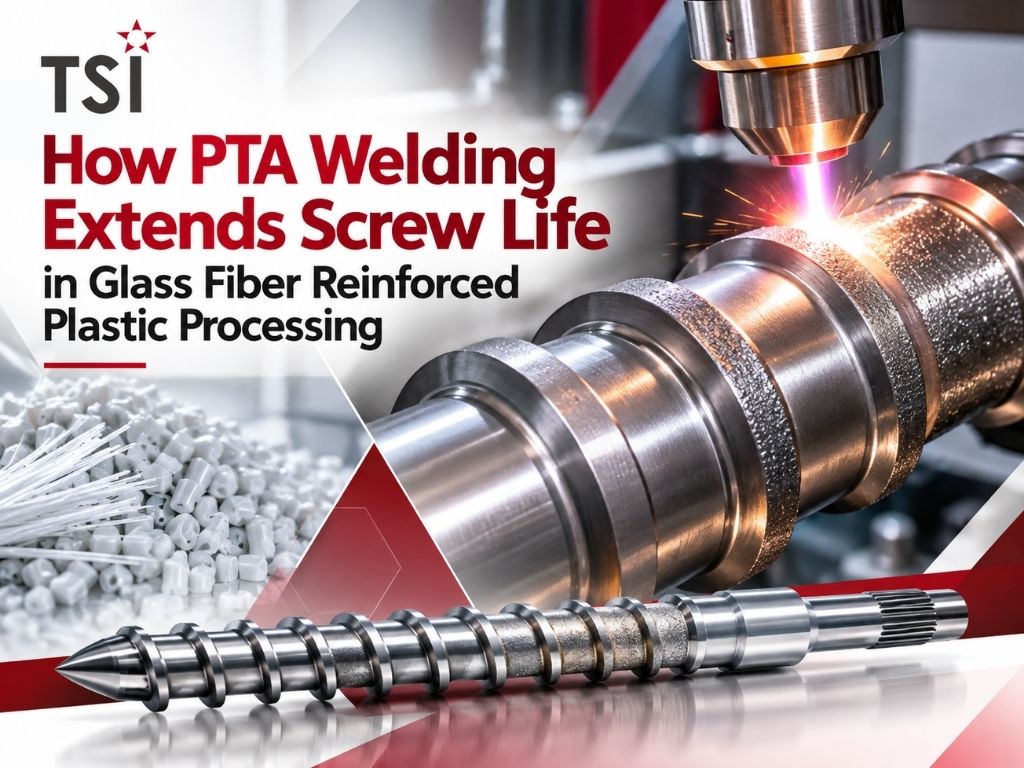
Glass fiber reinforced plastics are widely used in automotive components, electrical equipment, industrial machinery, and other applications requiring high strength, stiffness, and dimensional stability. However, while glass fibers improve the mechanical properties of molded products, they also create demanding wear conditions for plastic processing equipment.
During injection molding and extrusion, abrasive glass fibers repeatedly contact the screw flights and surrounding surfaces. Over time, this can accelerate screw wear, affect plasticizing efficiency, and increase maintenance requirements.
PTA Welding (Plasma Transferred Arc Welding) is one method of improving screw durability. By depositing a wear-resistant alloy onto critical screw surfaces, particularly the screw flights, PTA welding helps protect areas exposed to repeated abrasive contact.
For manufacturers processing glass fiber reinforced plastics, understanding how PTA welding works—and when it is appropriate—can help them select a more suitable screw solution.
TAN STAR INDUSTRIES INC. offers PTA-welded screw solutions with different alloy compositions, hardness levels, and wear-resistance characteristics to address varying plastic processing requirements.
1. Why Do Glass Fiber Reinforced Plastics Cause Screw Wear?
Glass fibers increase abrasive wear because they are hard reinforcing materials that repeatedly contact metal surfaces during plasticizing.
As the screw rotates, it conveys, compresses, melts, and mixes the plastic material. Glass fibers within the resin move through the screw channels, creating abrasive contact with the screw flights and other working surfaces.
The severity of wear depends on several factors:
- Glass fiber content: Higher reinforcement levels can increase abrasive loading.
- Resin type: Different polymers require different processing temperatures and conditions.
- Additional fillers: Mineral fillers and other reinforcing materials can contribute to abrasion.
- Processing conditions: Screw speed, back pressure, throughput, and temperature influence mechanical and thermal loading.
- Screw material and surface protection: Alloy selection affects resistance to abrasive and corrosive environments.
What Happens When Screw Flights Wear?
Screw flights help maintain the dimensional relationship between the screw and barrel. When their outer surfaces gradually wear down, screw-to-barrel clearance may increase.
Excessive clearance can contribute to increased melt leakage over the flights, reduced conveying efficiency, and changes in plasticizing performance.
Possible warning signs include longer screw recovery times, inconsistent melt preparation, and increased difficulty maintaining stable processing conditions.
These symptoms are not exclusive to screw wear, however. Barrel condition, check-ring performance, material handling, and machine settings should also be evaluated before determining the cause.
Key Takeaway: Glass fiber content is an important consideration, but actual screw wear depends on the entire processing environment—not reinforcement percentage alone.
2. What Is PTA Welding for Plastic Processing Screws?
PTA Welding is a surface engineering process that uses a plasma arc to deposit a protective alloy layer onto selected areas of a metal component.
PTA stands for Plasma Transferred Arc. In this process, an electrical arc supplies the energy needed to melt the deposited alloy material and a controlled portion of the underlying substrate, creating a metallurgical bond.
For plastic processing screws, PTA welding is commonly used to reinforce the outer surfaces of screw flights.
How the PTA Welding Process Works
- Surface preparation: The screw area to be treated is prepared for alloy deposition.
- Plasma arc generation: A transferred plasma arc supplies concentrated thermal energy.
- Alloy deposition: The selected welding material is melted and deposited onto the screw flight.
- Metallurgical bonding: The deposited alloy bonds with the underlying screw material.
- Finishing and inspection: The treated screw is finished to the required dimensions and inspected for suitability.
Unlike a process that only modifies the existing metal surface, PTA welding adds a protective alloy layer to the treated area.
The final performance depends on the alloy composition, welding parameters, deposit quality, and subsequent finishing.
Key Takeaway: PTA welding provides localized alloy reinforcement, making it particularly relevant to screw flights exposed to abrasive plastic compounds.
3. How Does PTA Welding Help Extend Screw Service Life?
PTA welding can improve screw service life by strengthening surfaces that would otherwise experience repeated abrasive contact.
Improved Resistance to Abrasive Wear
A suitable PTA alloy provides a more wear-resistant working surface than an unprotected screw material in the intended application.
When glass fiber reinforced resin passes through the screw channel, the reinforced flight surface can better withstand abrasive contact, helping slow dimensional wear.
Protection of Critical Screw Geometry
The screw flights are important to material conveying and plasticizing performance.
By reducing wear at these surfaces, PTA welding can help preserve flight dimensions and maintain a suitable operating clearance between the screw and barrel for longer.
This can contribute to more consistent material processing over the component's service life.
Application-Specific Alloy Selection
PTA welding is not limited to a single alloy composition.
Different deposited alloys can offer different combinations of hardness, wear resistance, and corrosion resistance.
This allows the treatment to be selected according to the resin formulation and operating environment rather than relying on one universal specification.
Potential Reduction in Maintenance and Replacement Frequency
When the appropriate PTA alloy successfully slows wear, the screw may remain serviceable for a longer period.
For manufacturers operating continuously, this can reduce the frequency of wear-related maintenance and replacement.
However, actual service-life improvement varies by application and should not be expressed as a fixed percentage without comparative operating data.
Key Takeaway: The principal benefit of PTA welding is not simply increased hardness; it is the ability to protect critical screw surfaces against the wear mechanisms encountered in a specific application.
4. Which Parts of a Screw Benefit Most from PTA Welding?
Screw flights are a primary application area for PTA welding because their outer surfaces are exposed to repeated contact and must maintain a controlled relationship with the barrel.
The flights form the boundaries of the screw channels and help convey material through the plasticizing unit.
When their outer diameter decreases through wear, the effective clearance between the screw and barrel may increase.
PTA welding is therefore useful when localized reinforcement of the flight surfaces is required.
It is important to distinguish this from full-surface protection.
A PTA-welded flight does not automatically mean the entire screw surface has been coated or that every area of the screw has identical wear resistance.
Where broad surface protection is needed, other treatment technologies may be considered.
For this reason, the decision should begin with identifying where wear occurs, not simply which surface treatment has the highest reported hardness.
5. How Does Glass Fiber Content Affect PTA Alloy Selection?
Glass fiber percentage is an important starting point for selecting a PTA-welded screw, but the final decision must also consider corrosion resistance, resin chemistry, and operating conditions.
TAN STAR provides three PTA Welding alloy options with different hardness values and recommended glass fiber application ranges. The following specifications are based on the company's published product information.
TAN STAR PTA Welding Alloy Comparison
| Specification | S-59 #56 | S-59 #88 | S-59 #12 |
|---|---|---|---|
| Main Base | Ni | Ni | Co |
| Other Components | Cr | Cr / W | Cr / W |
| Inlay Hardness | HRC 52–55 | HRC 58–60 | HRC 44–48 |
| Wear Resistance | ★★★ | ★★★★ | ★★★☆ |
| Corrosion Resistance | ★★★★ | ★★★★ | ★★★★ |
| Glass Fiber Application | ≤10% | ≤25% | ≤10% |
Note: Published product ratings and application ranges are manufacturer specifications, not guaranteed service-life results.
S-59 #56: For Lower Glass Fiber Content
The nickel-chromium S-59 #56 alloy is specified for materials containing up to 10% glass fiber.
Its HRC 52–55 hardness and published resistance ratings make it an option for applications where corrosion protection and moderate abrasive resistance are required.
S-59 #88: For More Demanding Abrasive Applications
The nickel-chromium-tungsten S-59 #88 alloy provides higher reported hardness and wear resistance than S-59 #56.
With a published application range of up to 25% glass fiber, it is particularly relevant when reinforced materials create more demanding abrasive conditions.
For manufacturers experiencing accelerated screw-flight wear while processing glass-filled engineering plastics, this is an important option to evaluate.
S-59 #12: When Corrosion Resistance Is a Priority
S-59 #12 uses a cobalt-based alloy with chromium and tungsten.
Its published specifications emphasize corrosion protection for materials containing up to 10% glass fiber.
This option illustrates why the highest hardness is not always the deciding factor. Some processing environments require particular attention to chemical resistance rather than maximum abrasion resistance.
What About Glass Fiber Content Above 25%?
TAN STAR's published PTA options in this comparison are specified for glass fiber contents up to 25%.
These specifications should not be interpreted as proof that the same PTA alloys are suitable for every higher-reinforcement application.
When processing compounds containing more than 25% glass fiber, manufacturers should consult TAN STAR about other screw surface solutions, including applicable HVOF Spray Coating or Through Hardened options.
Key Takeaway: S-59 #88 offers the highest published glass fiber application range among these three PTA alloys, but the appropriate choice still depends on the complete material formulation.
6. PTA Welding vs. Other Screw Surface Treatments
PTA welding is particularly useful for localized screw-flight reinforcement, but it is not the only technology available for protecting plastic processing screws.
TAN STAR also offers HVOF Spray Coating and Through Hardened screw solutions. Each approach protects the component differently.
| Technology | Protection Approach | Main Consideration |
|---|---|---|
| PTA Welding | Deposits a metallurgically bonded alloy onto screw flights | Localized reinforcement of critical wear areas |
| HVOF Spray Coating | Applies a dense protective coating to prepared surfaces | Broader surface protection against wear and corrosion |
| Through Hardened | Uses hardened screw material rather than relying solely on a deposited layer | Material hardness and properties through the treated structure |
PTA welding may be a suitable choice when the main concern is wear at the screw-flight surfaces.
HVOF may be considered when broader screw surface protection is required, while Through Hardened solutions offer another approach based on material properties.
None of these technologies is universally superior. The appropriate solution depends on the location of wear, resin formulation, processing conditions, and required resistance to abrasion and corrosion.
For a more detailed comparison, see PTA Welding vs. HVOF Spray Coating: Which Surface Treatment Is Better for Plastic Processing Screws?
7. When Should Manufacturers Consider PTA-Welded Screws?
Manufacturers should consider PTA-welded screws when repeated abrasive wear at the screw flights is affecting component life or plasticizing performance.
Repeated Screw-Flight Wear
If inspections consistently reveal material loss along the screw flights, a localized wear-resistant alloy may help address the affected surfaces.
Processing Glass Fiber Reinforced Engineering Plastics
Applications involving reinforced PA, PBT, PPS, or other engineering resins may place greater abrasive demands on screw surfaces.
The actual reinforcement percentage and additives must be considered before choosing an alloy.
Frequent Screw Replacement
When screw replacement becomes a recurring maintenance expense, manufacturers can evaluate whether a more wear-resistant surface provides a suitable long-term alternative.
Maintaining Stable Production
Screw-flight wear may gradually affect conveying efficiency and plasticizing consistency.
Protecting the flights can help maintain the intended geometry for longer, although machine condition and processing settings remain important.
Combined Abrasion and Corrosion
Some reinforced compounds also contain additives that create corrosive conditions.
In these applications, PTA alloy selection should consider both wear and corrosion resistance.
Key Takeaway: PTA welding is most relevant when the location and mechanism of wear indicate that localized alloy reinforcement could provide meaningful protection.
8. How to Select the Right PTA Welding Solution
A suitable PTA-welded screw should be selected according to actual material and processing requirements rather than hardness alone.
Before selecting an alloy, manufacturers should evaluate the following information.
| Selection Factor | Questions to Consider |
|---|---|
| Resin Type | Which polymer or engineering plastic is being processed? |
| Glass Fiber Content | What percentage of glass fiber does the compound contain? |
| Other Additives | Are mineral fillers, flame retardants, or other additives present? |
| Wear Location | Is wear concentrated on the screw flights or distributed across the screw surface? |
| Corrosion Conditions | Are there signs of pitting or chemical attack? |
| Processing Requirements | What temperatures, screw speeds, and production conditions are involved? |
| Maintenance History | How frequently does the screw require inspection or replacement? |
Step 1: Identify the Material Formulation
Start with the exact resin grade, glass fiber content, and additional fillers.
A nominally similar resin may create different wear conditions when its reinforcement or additive package changes.
Step 2: Inspect the Existing Screw
Determine whether the primary damage is flight wear, corrosion, surface scoring, or a combination.
This helps establish whether localized PTA reinforcement addresses the actual problem.
Step 3: Compare PTA Alloy Specifications
Review the hardness, wear resistance, corrosion resistance, and published glass fiber application ranges of the available alloys.
For example, S-59 #88 may be considered for higher abrasive demands within its specified range, while S-59 #56 and S-59 #12 offer different performance balances for lower glass fiber content.
Step 4: Check the Barrel Condition
The screw and barrel operate together.
Excessive barrel wear can affect clearance and processing performance even when the screw flights have been reinforced.
Both components should therefore be evaluated when significant wear is suspected.
Step 5: Confirm the Solution with TAN STAR
Provide the processing material, operating conditions, component dimensions, and available wear history.
This information helps TAN STAR evaluate which PTA alloy—or alternative screw solution—is appropriate for the application.
9. Frequently Asked Questions
Which PTA welding alloy is suitable for screws processing plastics with 20% glass fiber?
For plastics containing 20% glass fiber, TAN STAR's S-59 #88 is an option to evaluate because its published application range covers glass fiber content up to 25%. It features a nickel-chromium-tungsten alloy with an inlay hardness of HRC 58–60.
However, glass fiber percentage alone does not determine suitability. Resin type, additional fillers, corrosion conditions, and operating parameters must also be considered before selecting the alloy.
Should manufacturers choose the PTA welding alloy with the highest hardness?
Not necessarily. Higher hardness does not automatically guarantee better performance in every plastic processing application.
For example, TAN STAR's S-59 #88 provides higher reported hardness and wear resistance than S-59 #56, making it relevant to more demanding abrasive conditions within its specified application range. However, other alloy options may be considered when corrosion resistance or different material requirements are priorities.
Manufacturers should evaluate both abrasive and corrosive wear mechanisms instead of selecting an alloy based solely on its HRC value.
10. Conclusion: Extending Screw Life Through Targeted PTA Protection
Glass fiber reinforced plastics create demanding abrasive conditions for plastic processing screws, particularly at the screw flights.
As these surfaces wear, screw geometry and the relationship between the screw and barrel can gradually change, potentially affecting conveying efficiency, plasticizing consistency, and maintenance requirements.
PTA Welding helps address this challenge by depositing a wear-resistant alloy onto critical screw-flight surfaces. The metallurgical bond and application-specific alloy selection make it a practical surface engineering option for suitable glass fiber reinforced plastic processing applications.
However, selecting the right PTA solution requires more than comparing hardness values. Manufacturers should consider the glass fiber percentage, resin formulation, corrosion risks, wear location, and operating conditions.
TAN STAR INDUSTRIES INC. offers multiple PTA Welding alloy systems, including S-59 #56, S-59 #88, and S-59 #12, to address different processing requirements.
Looking for a PTA Welding Solution for Glass Fiber Reinforced Plastics?
If you are experiencing screw wear while processing glass fiber reinforced plastics, contact TAN STAR INDUSTRIES INC. to discuss your material, processing conditions, and screw requirements.
Our team can help you evaluate a suitable PTA Welding solution for longer-lasting, more reliable plastic processing performance.
Related Articles
- What Is PTA Welding and Why Is It Used in Plastic Processing Screws?
Learn the fundamentals of PTA welding and its role in screw surface engineering.
- PTA Welding vs. HVOF Spray Coating: Which Surface Treatment Is Better for Plastic Processing Screws?
Compare the protection approaches and applications of the two technologies.
- How to Choose the Right Bimetallic Screw for Glass Fiber Reinforced Plastics?
Explore broader screw selection considerations for reinforced compounds.